For centuries, people have lived next to the Pacific coast, taking bounty from its waters and guarding themselves against its cataclysms. The bonds of humans with the sea and with each other form the unbreakable latticework that is the foundation of life here.
Opened in 2019 in Japan’s northern Tōhoku region, the 1,000-kilometre Michinoku Coastal Trail was created as a joint revitalisation effort by local governments and the Ministry of Environment to help the area rebuild after the devastating 2011 earthquake and tsunami, linking together the pockets of civilisation perched amidst the forest and the sea cliffs.
Oku Japan is proud to have worked closely with local entities to create this small-group guided tour. Join us in a group of no more than 13 like-minded travellers as we travel through the Sanriku Coast, which encompasses Aomori, Iwate, and northern Miyagi prefectures. Notable for its robust fishing and aquaculture industries, its remoteness, its rugged landscape and, above all, the remarkable warmth and resilience of its residents, this area is a look into a unique side of Japan.
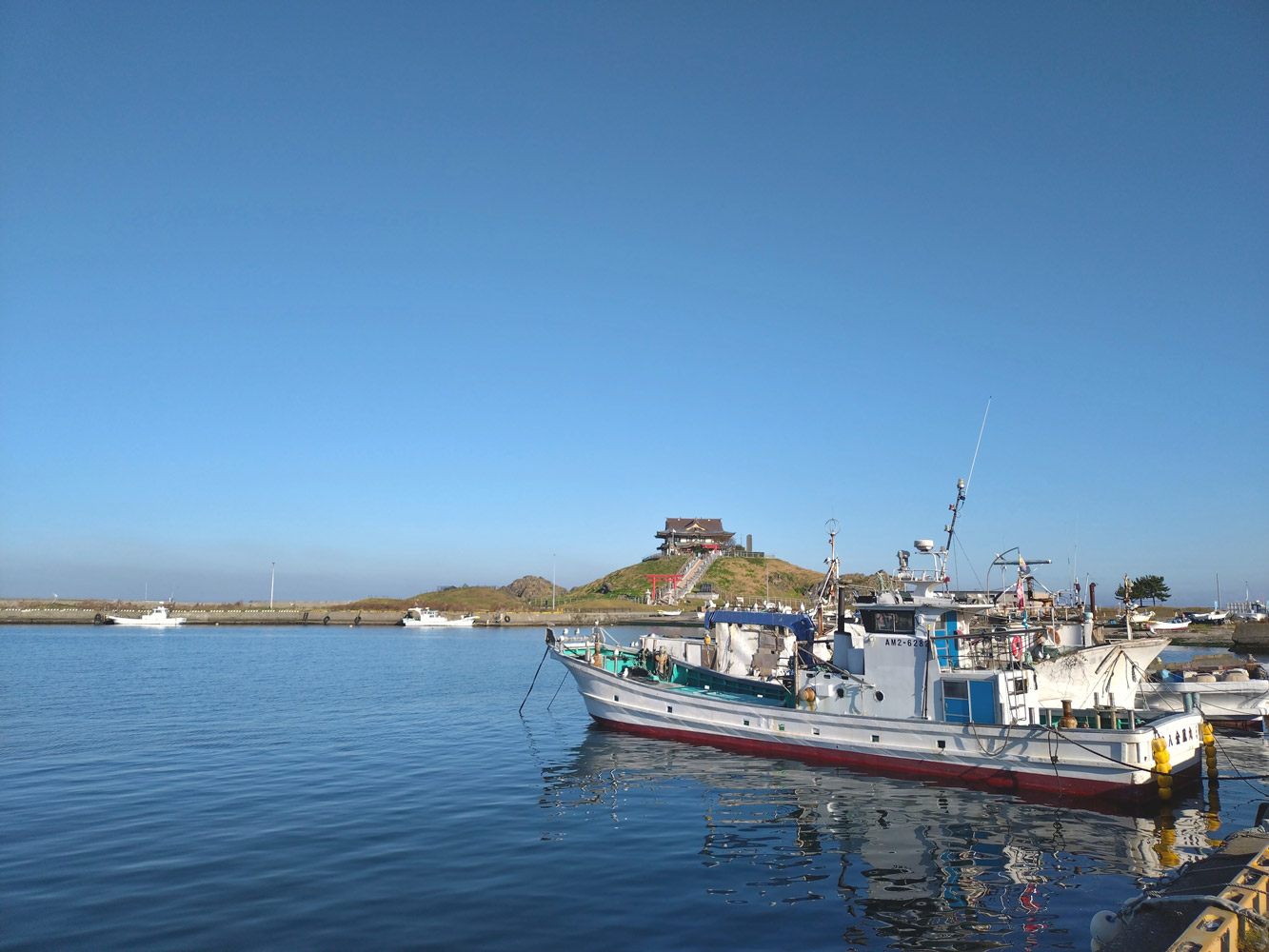
Starting from Kabushima Shrine, the Michinoku’s north trailhead, we will travel south, hiking through verdant forests and alongside rocky cliffs that plunge steeply into the waves below – the tallest of which can reach up to 200 metres above sea level! After our walk to the ‘paradise beach’ of Jōdogahama, the cliffs give way to a beautiful ria coastline that winds intricately alongside the Pacific Ocean.
In coastal towns and hamlets, we see the lifestyles that have sustained people for generations, centred around a sea that provides blessings and danger in turn. The way of life here is built on a culture of respect for the ocean, care for one another, and united strength through catastrophe.
In addition to our licensed bilingual Oku Japan guide, local guides and members of the community will teach us about industries key to life here, such as Kesennuma’s bustling fishing harbour, whose catches are shipped all throughout Japan. We will see the traditions that have continued to thrive and inspire, such as local dances with roots in Shintō and folk culture that have sustained spirits in times of strife, and hear tales of regrowth and rebirth in the years since the tsunami.
Above all, we will glimpse into the livelihoods that people have built by propping each other up, following the concept of ongaeshi, or reciprocity, all against a backdrop of dramatic rocky coasts, beautiful beaches, and lush mixed forests.
Please note that this tour heavily features seafood due to the culture and cuisine of the region. As a result, we may be unable to accommodate diets that exclude fish and seafood.
Your tour highlights
- See the region’s stunning views, including Kabushima Shrine, the paradise beach of Jōdogahama, and the Goishi Coast
- See a traditional local dance unique to the region
- Enjoy the companionship of a knowledgeable bilingual guide
- Indulge in some of Japan’s freshest and most prized seafood
- Hike through mixed forests and along the beautiful and varied Sanriku coastline
- Meet members of the local community for an intimate look into the way of life here
Tour itinerary
Arrive in Hachinohe and meet your guide at your hotel. You will enjoy a welcome dinner with your group later in the evening.
Meals: Dinner
Accommodation: Western-style hotel
Take a short train ride to the northern trailhead of the Michinoku Coastal Trail at Kabushima Shrine. This shrine is well-known for its abundance of black-tailed gulls which are most active from spring to the end of summer. Walk south along beautiful Tanesashi Coast with its green grass, flowers, and clear ocean views.
Overnight at an accommodation near the border of Aomori and Iwate prefectures.
Walking distance: 9.5 km / 5.9 mi
Elevation gain: 105 m / 350 ft of ascent and 90 m / 295 ft of descent
Time required: 3.5 – 4 hours
Meals: Breakfast, dinner
Accommodation: Japanese-style accommodation
From Samurai Rock, a massive slab with unbelievable views over the coast and an interesting history, we will travel south (past a shrine that has a connection to Miyajima’s famous Itsukushima Shrine) to arrive in the city of Kuji, known for ama, female abalone divers. Stay the night here at a hotel.
Walking distance: 9.2 km / 5.7 mi
Elevation gain: 395 m / 1,295 ft of ascent and 315 m / 1,035 ft of descent
Time required: About 4 hours
Meals: Breakfast, dinner
Accommodation: Western-style hotel
Arrive in the town of Fudai by train. Fudai is
known for its incredible story of survival: during
the 2011 tsunami, its floodgate miraculously
protected the town and its residents from waves
as high as 20 metres (66 feet).
From the floodgate, take a pre-arranged taxi
to Kurosaki Fishing Port, then walk up to
Kurosaki Viewpoint for spectacular coastal
views. Afterwards, travel by pre-arranged taxi
to Cape Kitayamazaki, where you’ll see some of
the Michinoku Coastal Trail’s most memorable
seascapes.
Walking distance: 1.9 km / 1.2 mi
Elevation gain: 190 m / 625 ft of ascent and 55 m / 185 ft of descent
Time required: about 1 hour
Meals: Breakfast, dinner
Accommodation: Minshuku (family-run guesthouse)
Today’s walk will weave through beautiful mixed forests and along the striking coastline, to the stunning white-sand beach of Jōdogahama. Enjoy sights of jagged cliffs, tranquil bays, and small hamlets along the way.
Overnight at a Japanese-style hotel this evening.
Walking distance: 6.2 km / 3.8 mi
Elevation gain: 330 m / 1,080 ft of ascent and 320 m / 1,055 ft of descent
Time required: About 2.5 hours
Meals: Breakfast, dinner
Accommodation: Japanese-style hotel
In the morning, set out for Todogasaki Coast, enjoying the jagged, scenic coastline as you hike through the lush pine forest.
In the evening, experience one of the unique performing arts of the region; beloved local traditions which became an emotional anchor in difficult times. Overnight at a Japanese-style hotel, and end your day by relaxing in a bath with ocean views.
Walking distance: 9.7 km / 6 mi
Elevation gain: 485 m / 1,595 ft of ascent and 505 m / 1665 ft of descent
Time required: 4 hours
Meals: Breakfast, dinner
Accommodation: Japanese-style hotel
Take a train to Yoshihama, which is known as a ‘miracle village’; despite the damage to it during the 2011 tsunami, it only suffered one human casualty.
Walk over Rasei-tōge Pass to Okirai, where you will see memorials to the earthquake and tsunami, as well as a 7,000 year-old cedar tree that withstood the wave. Arrive at your accommodation, with time in the evening to explore the town.
Walking distance: 8.6 km / 5.3 mi
Elevation gain: 340 m / 1,110 ft ascent and 350 m / 1,145 ft descent
Time required: 3.5 hours
Meals: Breakfast
Accommodation: Western-style hotel
Walk the loop along the Goishi Coast, named for its stones that look like pieces from the board game Go. Scenic points along the way include the Ranbōya Gorge with its 30-metre-high walls and Thunder Rock, one of the officially designated ‘100 soundscapes of Japan’ due to the rumbling sound of water through its caverns. After the walk, we will take a pre-arranged taxi to the Iwate Tsunami Memorial Museum before arriving at our accommodation for the night.
Walking distance: 9 km / 5.6 mi
Elevation gain: 305 m / 1,000 ft of ascent and 265 m / 870 ft of descent
Time required: 4 hours
Meals: Breakfast, dinner
Accommodation: Minshuku (family-run guesthouse)
Travel by train to Kesennuma, a fishing city that is one of Japan’s largest sources of swordfish and skipjack tuna, whose large port plays host to boats from throughout Japan. Like many other areas along the Sanriku coast, Kesennuma was hit particularly hard by the 2011 earthquake and tsunami, but has come a long way in rebuilding in the years since. You will visit the Kesennuma City Memorial Museum, located in the ruins of a school building and take a tour with a local guide. In the afternoon, explore the lively city at your leisure, before joining your group for a farewell dinner in the evening.
Meals: Breakfast, dinner
Accommodation: Ryokan (Japanese-style inn)
Join a guided tour of the bustling Kesennuma Fish Market in the morning before your breakfast. Bid farewell to your tour group, then continue onwards to your next destination from Kesennuma station.
Meals: Breakfast
What you’ll see on the tour



Tour pricing:
from $4,315
2027 departures:
21-30 June
6-15 September
To secure your place now:
Phone: 03 364 3400 or 0800 747 737
Email: [email protected]
Tour Inclusions:
Full-time services of an English-speaking tour guide
9 nights in hotels and Japanese-style accommodations
Daily breakfast and 8 dinners
All transportation between tour locations
Daily luggage transfer of 1 item of luggage
Admission to a performance of a traditional local dance
Entrance fees for sites and activities listed on the group’s itinerary